
We acknowledge the traditional custodians of the land on which these plants grow - the Darug and Gundungurra people - and pay respect to their Elders past, present and emerging.
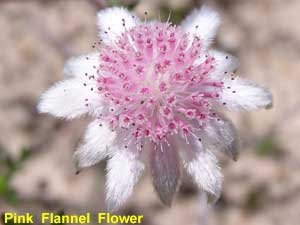 Pink Flannel Flower (Actinotus forsythii)
This set of wildflowers is "simply" those that belong to smaller floral families - of which there are over 180 families with over 2,000 species in the Blue Mountains. This includes over 600 "introduced species" (weeds).
The largest family is the grasses - Family Poaceae - with over 280 species (including 100 weeds). However, this website doesn't cover this family - yet.
Next is the Family Asteraceae (daisies) with over 220 species (including 70 weeds).
Note: The location of photos not taken in the Blue Mountains is shown in lime green. LCNP is the Lane Cove National Park.
- Acid Drops
- Andromeda Pomaderris
- Angel Sword
- Apple Berry
- Barbwire Vine
- Bearded Tylophora
- Bear's Breeches *
- Bird's-eye Speedwell *
- Bitter Cryptandra
- Black Sassafras
- Black Wattle
- Black-eyed Susan
- Blue Dampiera
- Blue Pincushion
- Blueberry Ash
- Blunt Sandalwood
- Bridal Daisy Bush
- Broad-leaf Star Hair
- Broom Milkwort
- Broom Spurge
- Buddleja *
- Bursaria longisepala
- Button Everlasting
- Carrot Tops
- Cliff Eyebright
- Clustered Poranthera
- Coachwood
- Common Centaury *
- Common Dog-violet *
- Common Lagenophora
- Common Silkpod
- Common St. Johns Wort *
- Coreopsis *
- Creamy Candles
- Creeping Buttercup *
- Curly Wig
- Dandelion *
- Digger's Speedwell
- Dolly Bush
- Downy Chance
- Drooping Mistletoe
- Dwarf Flannel Flower
- Elderberry Panax
- Fairies’ Wings
- Fireweed *
- Fireweed Groundsel
- Flatweed *
- Forest Starwort
- Forked Comb Fern
- Forked Sundew
- Foster's Lagerphone *
- Golden Everlasting
- Goodenia decurrens
- Goodenia heterophylla subsp. heterophylla
- Goodenia heterophylla subsp. montana
- Grass Daisy
- Grass Trigger-plant
- Greater Periwinkle *
- Headache Vine
- Heartsease *
- Heath-leaved Poranthera
- Heathy Platysace
- Himalayan Honeysuckle *
- Hop Goodenia
- Ivy Goodenia
- Lantana *
- Japanese Honeysuckle *
- Large Bindweed
- Large Mock-olive
- Lesser Flannel Flower
- Lilac Mint Bush
- Louisa's Mistletoe
- Love Creeper
- Matchheads
- Milkmaids
- Mountain Blueberry
- Mountain Clematis *
- Mountain Silkpod
- Mountain Violet
- Narrow-leaf Logania
- Narrow-leaved Mint-bush
- Narrow-leaved Triggerplant
- Native Parsnip
- Native Passionfruit
- Native Sarsaparilla
- Native Violet
- NSW Christmas Bush
- Oak-leaved Olearia
- Olax
- Old Man's Beard
- Orange Thorn
- Paddy's Lucerne *
- Pagoda Rock Daisy
- Pastel Flower
- Pincushion *
- Pink Flannel Flower
- Pink-tip Daisy-bush
- Pinnate Hop Bush
- Prickly Sowthistle *
- Purple Coopernookia
- Purple Dampiera
- Purple Eyebright
- Purpletop Verbena *
- Red Rusty-petals
- Rice-flower Pseudanthus
- River Rose
- Rough Daisy-bush
- Rough Fruit Pittosporum
- Rusty Velvet-bush
- Sandstone Violet
- Satin Everlasting
- Scarlet Pimpernel *
- Scented Marsdenia
- Sheoak Mistletoe
- Shoddy Ragwort
- Single Bladderwort
- Slender Bindweed
- Slender Rice Flower
- Slender Stackhousia
- Slender Violet-bush
- Small-leaved Privet *
- Small Poranthera
- Small St. John's Wort
- Snake Flower
- Spear Thistle *
- Spoon-leaved Sundew
- Star Xanthosia
- Sticky Daisy Bush
- Stiff Cassinia
- Sweet Pittosporum
- Sydney Flannel Flower
- Tarata *
- Thyme Mitrewort
- Thyme Spurge
- Toothed Daisy-bush
- Tree Trigger-plant
- Tree Violet
- Triggerplant
- Tutsan *
- Variable Muttonwood
- Variable-leaved Goodenia
- Varied Mitrewort
- Velvet Pink
- Veronica brownii
- Wedding Bush
- White Burr Daisy
- White Paper Daisy
- White Marianth
- White Root
- White Sour Bush
- Woolly Xanthosia
- Xanthosia scopulicola
- Yellow Archangel *
- Yellow Cassinia
* Introduced species (weed)
- Acanthus mollis *
- Actinotus forsythii
- Actinotus gibbonsii
- Actinotus helianthi
- Actinotus minor
- Amperea xiphoclada
- Amyema cambagei
- Amyema pendula subsp. pendula
- Astrotricha latifolia
- Atherosperma moschatum subsp. integrifolium
- Atkinsonia ligustrina
- Bauera rubioides
- Billardiera scandens
- Brachyscome graminea
- Brunonia australis
- Buddleja davidii *
- Burchardia umbellata
- Bursaria longisepala
- Callicoma serratifolia
- Calotis dentex
- Calystegia sepium subsp. roseata
- Cassinia aculeata subsp. aculeata
- Cassinia aureonitens
- Cassinia denticulata
- Caustis flexuosa
- Centaurium erythraea *
- Ceratopetalum apetalum
- Ceratopetalum gummiferum
- Choretrum candollei
- Cirsium vulgare *
- Clematis aristata
- Clematis glycinoides
- Clematis montana *
- Clerodendrum tomentosum
- Comesperma defoliatum
- Comesperma ericinum
- Comesperma sphaerocarpum
- Comesperma volubile
- Coopernookia barbata
- Coreopsis lanceolata *
- Coronidium elatum subsp. elatum
- Coronidium scorpioides
- Cryptandra amara
- Dampiera purpurea
- Dampiera stricta
- Dodonaea pinnata
- Drosera binata
- Drosera spatulata
- Elaeocarpus holopetalus
- Elaeocarpus reticulatus
- Euphrasia bowdeniae
- Euphrasia collina subsp. paludosa
- Goodenia decurrens
- Goodenia hederacea subsp. hederacea
- Goodenia heterophylla subsp. heterophylla
- Goodenia heterophylla subsp. montana
- Goodenia ovata
- Helichrysum leucopsideum
- Hybanthus monopetalus
- Hypericum androsaemum *
- Hypericum gramineum
- Hypericum perforatum *
- Hypochaeris radicata *
- Lagenophora stipitata
- Lagerphonia fosteri *
- Lamium argentatum *
- Lantana camara *
- Lasiopetalum ferrugineum var. ferrugineum
- Lasiopetalum rufum
- Leptomeria acida
- Leucochrysum graminifolium
- Leycesteria formosa *
- Ligustrum sinense *
- Lobelia dentata
- Lobelia purpurascens
- Logania albiflora
- Lonicera japonica *
- Lysimachia arvensis *
- Marsdenia suaveolens
- Melicytus dentatus
- Mitrasacme polymorpha
- Mitrasacme serpyllifolia
- Myrsine variabilis
- Notelaea longifolia
- Olax stricta
- Olearia asterotricha subsp. glaucophylla
- Olearia elliptica subsp. elliptica
- Olearia erubescens
- Olearia microphylla
- Olearia quercifolia
- Olearia tomentosa
- Parsonsia brownii
- Parsonsia straminea
- Passiflora herbertiana subsp. herbertiana
- Petrorhagia dubia *
- Phyllanthus hirtellus
- Pimelea linifolia subsp. linoides
- Pittosporum eugenioides *
- Pittosporum multiflorum
- Pittosporum revolutum
- Pittosporum undulatum
- Platysace ericoides
- Platysace lanceolata
- Platysace linearifolia
- Polymeria calycina
- Polyscias sambucifolia
- Pomaderris andromedifolia
- Poranthera corymbosa
- Poranthera ericifolia
- Poranthera microphylla
- Prostanthera caerulea
- Prostanthera linearis
- Pseudanthus pimeleoides
- Pseuderanthemum variabile
- Ranunculus repens *
- Rhytidosporum procumbens
- Ricinocarpos pinifolius
- Santalum obtusifolium
- Scabiosa atropurpurea *
- Scaevola ramosissima
- Schizaea bifida
- Senecio linearifolius var. macrodontus
- Senecio madagascariensis *
- Senecio pterophorus *
- Sida rhombifolia *
- Smilax australis
- Smilax glyciphylla
- Sonchus asper *
- Stackhousia monogyna
- Stackhousia viminea
- Stellaria flaccida
- Stylidium graminifolium
- Stylidium laricifolium
- Stylidium lineare
- Stylidium productum
- Taraxacum officinale *
- Tetratheca ericifolia
- Tetratheca rupicola
- Tylophora barbata
- Utricularia uniflora
- Verbena bonariensis *
- Veronica brownii
- Veronica perfoliata
- Veronica persica *
- Vinca major *
- Viola betonicifolia
- Viola hederacea
- Viola riviniana *
- Viola silicestris
- Viola tricolor *
- Xanthosia pilosa
- Xanthosia scopulicola
- Xanthosia stellata
- Xerochrysum bracteatum
* Introduced species (weed)
The Acanthaceae family includes some 2,500 species worldwide. There are three natives species recorded as being in the Blue Mountains - the two not shown here are Brunoniella australis (Blue Trumpet) and Brunoniella pumilio (Dwarf Blue Trumpet).

Bear's Breeches
Acanthus mollis
Its huge leaves are 50cm long and 30cm wide.

Besides flannel flowers, this family includes carrots and celery and a host of herbs such as parsley, coriander and fennel. Also see our Flannel Flowers web page.
There's 5 Actinotus species in NSW, 4 of which can be found in the Blue Mountains. The 5th, the Clustered Flannel Flower (Actinotus paddisonii), is found out west around Bourke.
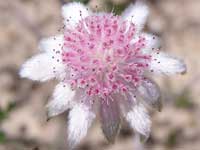
Pink Flannel Flower
Actinotus forsythii
The flowers are 20mm in diameter.
Here's another image and another.
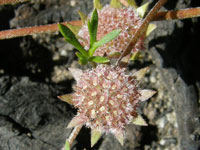
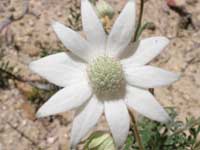
Sydney Flannel Flower
Actinotus helianthi
The forked hairy green leaves help identify it when not in flower.
The flowers are 50mm in diameter.
Here's another image.
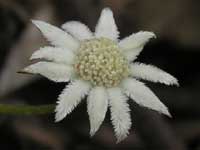
Lesser Flannel Flower
Actinotus minor
It seems to always be in flower.
Here's another image and another.


Its white/creamy/sometimes pinkish flowers are in umbels* and its petals have a ridge in the middle. Its leaves are variable.
* An umbel is where flower-stalks arise from one point at the top of a stalk.
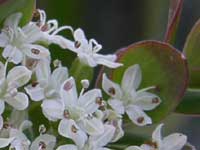
Native Parsnip
Platysace lanceolata
The mountain heath form has broad leaves. A form found in the Lane Cove National Park has lance like leaves.
Here's another image.
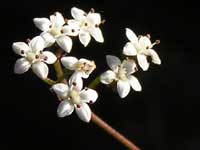
Carrot Tops
Platysace linearifolia
Its long thin leaves also helps identify it.

Heathy Platysace
Platysace ericoides
Its 2mm wide flowers appear in spring to autumn.
Here's another image.
The Xanthosia genus is endemic to Australia with 20 species overall with 6 found in the Blue Mountains.
Its flowers readily identify the genus, while the lobed leaves help identify the species.
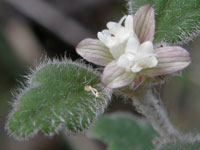
Woolly Xanthosia
Xanthosia pilosa
This image shows the underside of the leaves.
Here's another image and another and another.
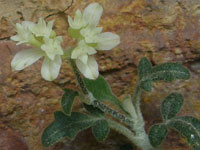
Xanthosia scopulicola
Its white flaky stems helps identify it.
It’s a shrub to 20cm high and its 10mm wide flowers appear in summer.
Here's another image and another.

Star Xanthosia
Xanthosia stellata
Its bracts/petals become dark red.
Here's another image.
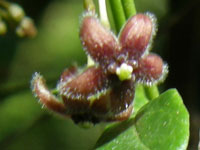
Bearded Tylophora
Tylophora barbata
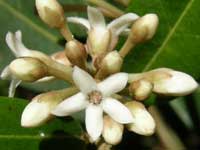
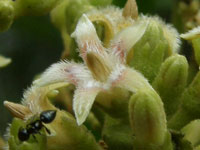
Common Silkpod
Parsonsia straminea
The leaves of P. straminea are finely reticulated.

Mountain Silkpod
Parsonsia brownii
They have a hairy throat.
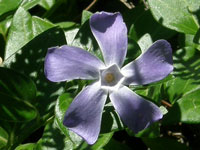
Greater Periwinkle
Vinca major
It is also known as Blue Periwinkle and Vinca.
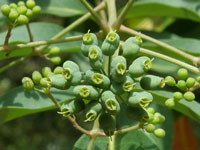
Elderberry Panax
Polyscias sambucifolia
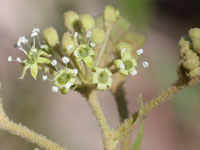
Broad-leaf Star Hair
Astrotricha latifolia
Its broad leaves can be 20cm long and 8cm wide. The flowers are 4mm wide.
Its light green petals distinguish it from A. longifolia whose petals are whitish.
The daisy family (Asteraceae) comprises around 24,000 species distributed worldwide - making it the second largest family of flowering plants in the world after the Orchidaceae (orchids) family's 25,000. They include many horticultural plants (e.g. chrysanthemum, gerbera) and crops (e.g. artichoke, lettuce, stevia, sunflower).
[source: Kew Gardens]
PlantNet shows 970 species in Australia with 225 in the Blue Mountains - a third of these being weeds.
Cassinia species are primarily endemic to Australia. With five species endemic to New Zealand. Its clustered flower heads help identify it. There are 47 species in Australia of which 8 are in the Blue Mountains.

Dolly Bush
Cassinia aculeata subsp. aculeata

Yellow Cassinia
Cassinia aureonitens

Stiff Cassinia
Cassinia denticulata
Lagenophora species occur in Southeast Asia, Central America, South America, New Zealand and Australia. Worldwide there are 25 species with 9 endemic to Australia of which 3 are recorded as being in the Blue Mountains.

Common Lagenophora
Lagenophora stipitata
Its flowers can be pale pink, blue or mauve.
Here's another image.

Foster's Lagerphone
Lagerphonia fosteri
Its numerous shiny double sided leaves nails it.
It is known to hybridise with L. xxxxii and L. coopersia.
The Olearia genus is endemic to Australasia, with 112 species in Australia of which 11 are in the Blue Mountains.
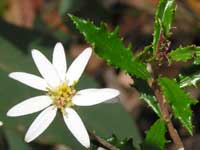
Pink-tip Daisy-bush
Olearia erubescens
The shiny prickly leaves helps identify this species, as does the redness underneath the leaves.
The newer leaves are dark red.
Here's another image.
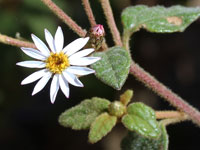
Toothed Daisy-bush
Olearia tomentosa
[mucro: a short point at the end of a leaf.]
Its leaves are around 40mm long and 20mm wide.
Here's another image and another.
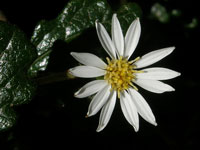
Oak-leaved Olearia
Olearia quercifolia
It is only found in the Blue Mountains.
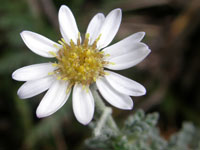
Rough Daisy-bush
Olearia asterotricha
subsp. glaucophylla
Here's another image of its leaves.
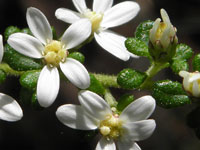
Bridal Daisy Bush
Olearia microphylla
Here's another image.

Sticky Daisy Bush
Olearia elliptica subsp. elliptica
The leaves are alternate and scattered and their stalks are 10mm long.
Here's another image and another.
The other subspecies (praetermissa) lives on Lord Howe Island.
The Senecio genus contains a staggering 1,250 species which makes it one of the largest genera of flowering plants.
There are 50 species that are native to Australia of which 12 are in the Blue Mountains.
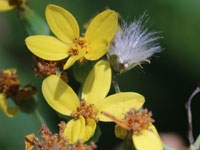
Fireweed Groundsel
Senecio linearifolius var. macrodontus
N.B. There are 23 Senecio species in the Blue Mountains - several without a description or identification key on PlantNet.
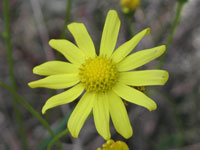
Fireweed
Senecio madagascariensis
Its 13-15 ray florets (petals) differentiates it from the native Fireweed Groundsel (Senecio linearifolius) that has 4-8.
Here's another image.

Shoddy Ragwort
Senecio pterophorus
Its variable toothed leaves are white “cobwebby” underneath.
Its 15mm wide flowers appear in summer.
Here's an image from underneath.
Other Asteraceae species

Grass Daisy
Brachyscome graminea
It flowers from spring through autumn. Its flowers are 20mm wide.
Brachyscome species are primarily endemic to Australia.
Brachyscome is spelt Brachycome in some sources.
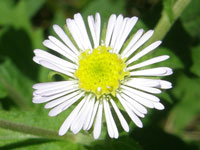
White Burr Daisy
Calotis dentex
Here's an image with a pollinator - a hover fly.
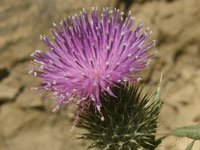
Spear Thistle
Cirsium vulgare
The Spear Thistle is also known as the Bull Thistle, and is a native of North Africa, Europe and Asia.
Here's an image of its seeds ready for take off.
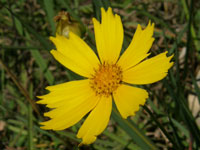
Coreopsis
Coreopsis lanceolata
The story goes that a traveller thinking that our native flora was bland, threw Coreopsis seeds from railway carriages.

White Paper Daisy
Coronidium elatum subsp. elatum
Its leaves are a dull green on top and white underneath.
It is the only C. elatum subspecies in the Blue Mountains.
Here's another image.
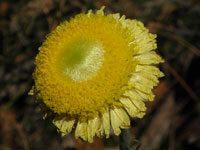
Button Everlasting
Coronidium scorpioides
It is identified by its 30mm wide flowers and a rosette of 90mm long hispid (bristly) leaves each with a mucro.
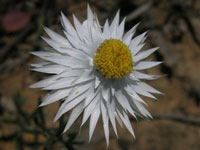
Satin Everlasting
Helichrysum leucopsideum
The flower on the left of this image is almost ready to release its seeds.
Here's an image of its leaves.
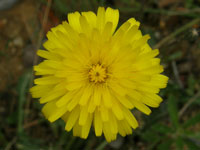
Flatweed
Hypochaeris radicata
Also known as Catsear, its cypsela (dry single-seeded fruit) is typical of most members of the Asteraceae family.

Pagoda Rock Daisy
Leucochrysum graminifolium
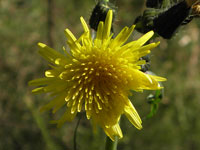
Prickly Sowthistle
Sonchus asper
As does its unique often pinnatisect (cut down to the midrib) leaves.

Dandelion
Taraxacum officinale
Its leaves, although in the form of a rosette, are not ground hugging.
Its flowers, which are solitary at the end of the stalk are 40mm wide and flower throughout the year.

Golden Everlasting
Xerochrysum bracteatum
Its dull leaves are 80mm long and 15mm wide.
Its flower stems are slightly woolly.
The other Xerochrysum species in the Blue Mountains (X. viscosum - Sticky Everlasting) has narrow sticky leaves.
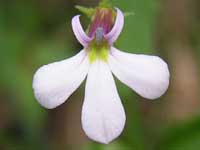
White Root
Lobelia purpurascens
The undersides of its leaves are purplish. Its 10mm flowers appear in the warmer months.
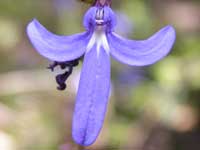
Angel Sword
Lobelia dentata
Known as the honeysuckle family, it has some 860 species none of which are native to Australia. Species include the abelia shrub and valerian herb.
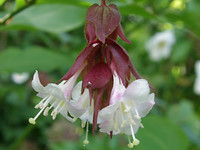
Himalayan Honeysuckle
Leycesteria formosa
It's a native of the Himalayas and western China.
Here's another image and another.
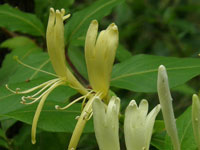
Japanese Honeysuckle
Lonicera japonica
Its toothless leaves and red stems help identify it when not in flower.
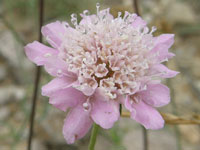
Pincushion
Scabiosa atropurpurea
A family of some 2,625 species and includes the carnation (Dianthus caryophyllus) and one of only two flowering plants found in Antarctica - Colobanthus quitensis (Antarctic Pearlwort).

Velvet Pink
Petrorhagia dubia
A plant to 60cm in height, its leaves may help identify it.
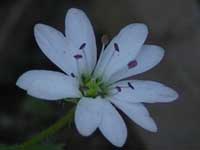
Forest Starwort
Stellaria flaccida
The Celastraceae family is a mainly tropical family of some 1,350 species.
Genus Stackhousia (candles)
Once you see a tiny Stackhousia flower with its five petals and long floral tube, you will easily recognise it again.
There are two Stackhousia species in the Blue Mountains.
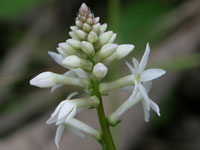
Creamy Candles
Stackhousia monogyna
The flowers, or more correctly, the corolla tube, is 7mm long and 7mm wide when open.
The flowers appear singly along the stem.
The leaves can be up to 30mm in length and 4mm wide.
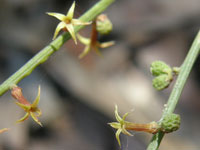
Slender Stackhousia
Stackhousia viminea
The corolla tube is less than 5mm in length, smaller than Creamy Candles, the flowers appear singly or in small groups.
The wrinkly seed pod is called a coccus.
Here's another image.
The Morning Glory family has more than 1,650 species. It includes the sweet potato (Ipomoea batatas).
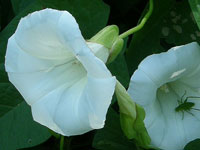
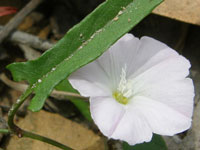
Slender Bindweed
Polymeria calycina
The two large sepals also help identify it.
Here's another image and one with the more standard pink flower.
There's seven members of the Cunoniaceae family in the Blue Mountains.
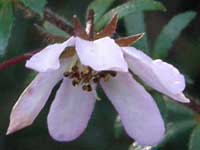
River Rose
Bauera rubioides
Its flowers are 15mm wide, and its leaves 7mm by 2mm. Its stems are hairy.
It is also known as the Dog Rose.
Here's another image and another.
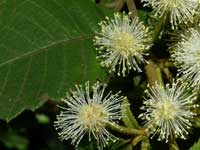
Black Wattle
Callicoma serratifolia
Its serrated leaves are up to 12cm long, and its velvety new leaves are pleasing to gently touch.
This image shows its dramatic new growth. It is the only species in its genus.

Coachwood
Ceratopetalum apetalum
Its flowers, like that of the Christmas Bush, are white - it’s its bracts that turn red in summer and provide a stunning vista from lookouts.
It was used in early coach making, WWII .303 rifle butts and for the frame of the Mosquito fighter-bomber (an all wood construction!).
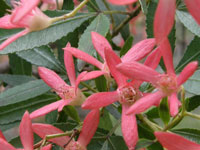
NSW Christmas Bush
Ceratopetalum gummiferum
However it produces white flowers - as shown here with its pollinators. It's its sepals that turn to red in fruit.
You’re more likely to see trees in their fine Christmas colours in the mid and lower Blue Mountains.
The Droseraceae family includes the Venus Fly Trap.
Genus Drosera - SundewsThere's 12 Drosera species in NSW, of which 9 are in the Blue Mountains
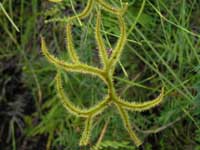
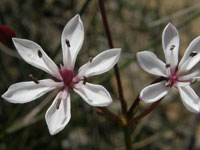
Forked Sundew
Drosera binata
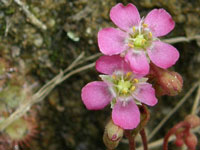
Spoon-leaved Sundew
Drosera spatulata
Genus Tetratheca - Black-eyed Susans
Genus Tetratheca formerly belonged to the Tremandraceae family. This family has now been absorbed into the Elaeocarpaceae family.
The NSW Flora Online describes some 14 species that occur in New South Wales. The species are collectively called Black-eyed Susans, and their similarity to each other provides a real challenge in identifying them.
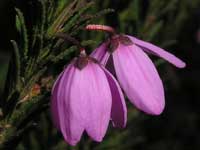
Black-eyed Susan
Tetratheca ericifolia
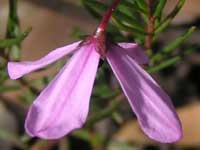
Black-eyed Susan
Tetratheca rupicola
There are 9 species in NSW with 3 in the Blue Mountains. Although they all have "blueberry" in their common name, they are not part of the blueberry family. Blueberries are members of the Heath family.
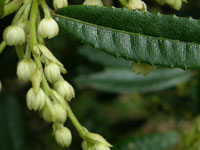
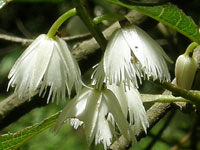
Blueberry Ash
Elaeocarpus reticulatus
(This pink variant was found in Jervis Bay.)
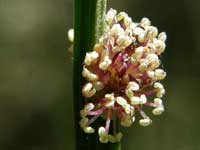
Broom Spurge
Amperea xiphoclada
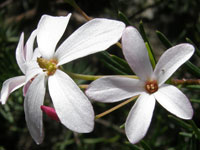
There's six genera of the Goodeniaceae family in the Blue Mountains totalling over thirty species.
Genus DampieraThere's three Dampiera species recorded as being in the Blue Mountains. The one missing from my collection is Purple Beauty Bush (Dampiera adpressa).
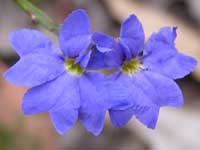
Blue Dampiera
Dampiera stricta
Also see our Blue Dampiera web page.
Here's an image of a white variant.
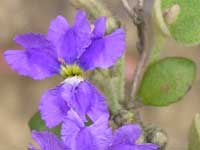
Purple Dampiera
Dampiera purpurea
Its oval leaves are also very different.
There's some fifteen Goodenia species recorded as being in the Blue Mountains. Goodenia heterophylla having three subspecies.
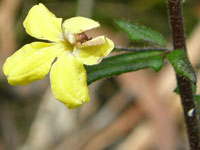
Goodenia heterophylla
subsp. heterophylla
Here's another image.
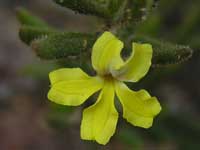
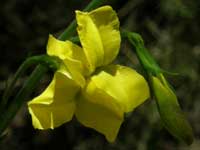
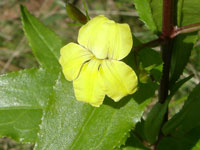
Hop Goodenia
Goodenia ovata
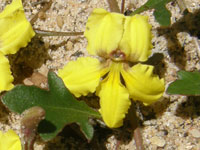
Ivy Goodenia
Goodenia hederacea subsp. hederacea
Other genera of the Goodeniaceae family
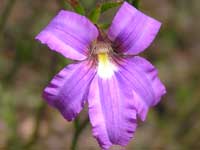
Snake Flower
Scaevola ramosissima
Here's images from side on and underneath.
Here's another image.
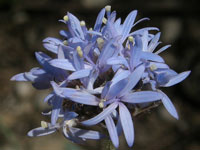
Blue Pincushion
Brunonia australis
It is found in all states, and in NSW away from the coast.
Its flowers are 15mm across.
Its basal leaves help identify it.
Here's another image.
The Hypericaceae family has over 700 species worldwide.
There's 490 species of the Hypericum genus with two native (but not endemic) to Australia - both being recorded in the Blue Mountains. The other native species (not shown here) is Japanese St. John's Wort (Hypericum japonicum).

Tutsan
Hypericum androsaemum
Tutsan has a ridge on both sides of its stems - front and back.
Here's another image.
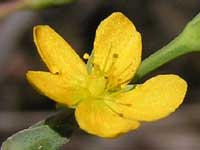

Common St. John's Wort
Hypericum perforatum
A shrub to 1m in height it has black glands on the edge of its petals and a ridge on its stems.
It is toxic to cows, sheep and horses, and probably native wildlife such as kangaroos.
The Lamiaceae or mint family has over 7,534 species worldwide and includes culinary herbs like basil, mint, marjoram, chia, oregano,
parsley, sage, rosemary and thyme. It also includes lavender and teak.
The 100+ species of the Prostanthera genus are endemic to Australia with 13 being recorded in the Blue Mountains. Identifying species can be difficult - and it is thought that they hybridize.

Lilac Mint Bush
Prostanthera caerulea
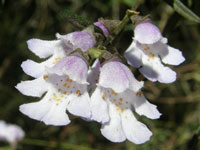
Narrow-leaved Mint-bush
Prostanthera linearis
Other genera of the Lamiaceae family

Downy Chance
Clerodendrum tomentosum

Yellow Archangel
Lamium argentatum
It knows no bounds and will take over a garden with a mat of its variegated leaves and a matching mat of roots.
Some references have it as L. galeobdolon subsp. argentatum
It has a fringe of hairs on its leaves.
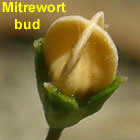
The orange flower bud is shaped like a bishop's hat - which is called a mitre - thus its name.
Missing from the gallery below are M. alsinoides, M. paludosa and M. pilosa.
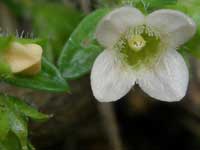
Thyme Mitrewort
Mitrasacme serpyllifolia
[The botanical word for this is "sessile".]
Its flowers are 6mm wide; its leaves are 6mm long and 2mm wide.
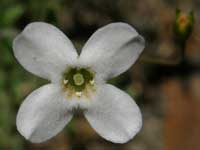
Varied Mitrewort
Mitrasacme polymorpha
It has very hairy branches and leaves.
This image shows the multiple flowers.
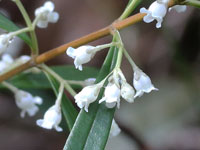
Narrow-leaf Logania
Logania albiflora
Here's another image.
Loranthaceae is a family of parasitic shrubs - both terrestrial and aerial.
There's eight species in the Blue Mountains across four genera.
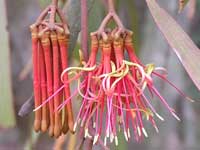
Drooping Mistletoe
Amyema pendula subsp. pendula
Its flowers are spectacular and very different to its host.
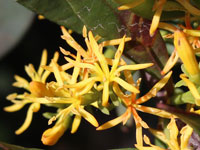
Louisa's Mistletoe
Atkinsonia ligustrina
It's a bush to 2 metres in height. The plants I have found are invariably near an Old Man Banksia (Banksia serrata).
Its 12mm long fruit matures from yellow to crimson.

Sheoak Mistletoe
Amyema cambagei
Its terete leaves are up to 15cm long and don't have the segments of its host.
The Malvaceae family includes cotton (Gossypium hirsutum) and the Hibiscus genus.
There's some 25 species of the Malvaceae family in the Blue Mountains across 12 genera including several native hibiscus species.
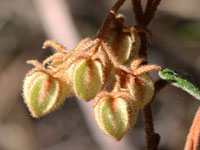
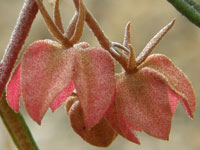
Red Rusty-petals
Lasiopetalum rufum
The leaves (rusty underneath) help proclaim it as a Lasiopetalum species.
Here's another image and another.

Paddy's Lucerne
Sida rhombifolia
Its partially serrated leaves are up to 8 cm long.
Here's another image.
The Oleaceae family is also known as the olive family. It includes olive, jasmine, ash and lilac species.
There's some 13 species of the Oleaceae family in the Blue Mountains.
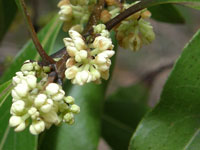
Large Mock-olive
Notelaea longifolia
Also noted are the conspicuous white lenticels - these are pores.
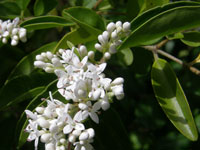
Small-leaved Privet
Ligustrum sinense
Genus Euphrasia - Eyebrights
Formerly included in the Scrophulariaceae family, this semi-parasitic plant's common name of Eyebright refers to the plant's use in treating eye infections.
There's 11 Euphrasia species in NSW, of which 3 are in the Blue Mountains.
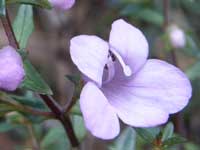
Cliff Eyebright
Euphrasia bowdeniae
It can be distinguished from other members of the genus by its leaves which have one set of "teeth", and its upper leaves are toothless.
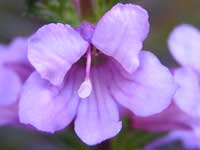
Purple Eyebright
Euphrasia collina subsp. paludosa
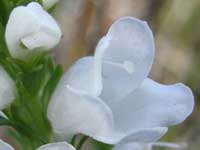
Purple Eyebright
Euphrasia collina subsp. paludosa
Family Phyllanthaceae was formerly part of the Euphorbiaceae family - see NSW Flora Online for more details.
Genus Poranthera
There's 6 Poranthera species in NSW, of which 3 are in the Blue Mountains.

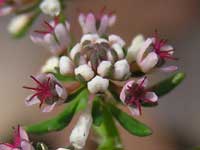
Heath-leaved Poranthera
Poranthera ericifolia
The flower-heads are held at the end of long branching stems and contain both male and female flowers.
The female flowers have red styles.
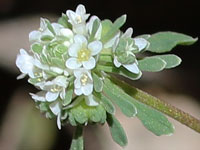
Small Poranthera
Poranthera microphylla
Other genera of the Phyllanthaceae family
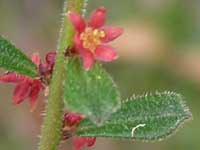
Thyme Spurge
Phyllanthus hirtellus
Family Picrodendraceae was formerly part of the Euphorbiaceae family - see NSW Flora Online for more details.
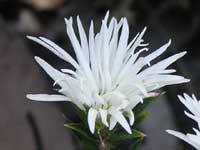
Rice-flower Pseudanthus
Pseudanthus pimeleoides
(The dahlia is Mexico's national flower.)
Flowering in Spring, the flower head contains multiple flowers. The name Rice-flower Pseudanthus is not widely used.
The Pittosporaceae family has some 200-240 species in 9 genera worldwide.
Genus Pittosporum
Pittosporum species are natives of Asia, Australasia, parts of the Middle East and several other regions with 3 native species recorded as being in the Blue Mountains.
Hybrid varieties of Pittosporum tenuifolium, a native of New Zealand, may be found in gardens in the Blue Mountains.
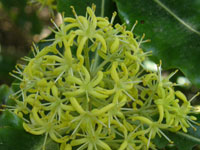
Tarata
Pittosporum eugenioides
Also known as Lemonwood due to the lemon fragrance of its crushed leaves.
Here's another image.
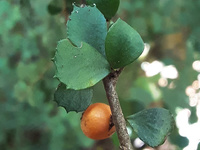
Orange Thorn
Pittosporum multiflorum
It has small toothed circular leaves.
Its spines come mainly from leaf axils.
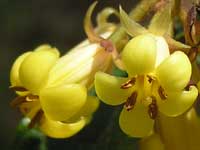
Rough Fruit Pittosporum
Pittosporum revolutum
It is also known as Wild Yellow Jasmine.
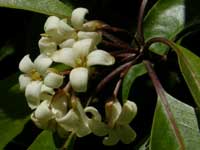
Sweet Pittosporum
Pittosporum undulatum
Flowering in spring, its sweet smelling white flowers fill the evening air.
The distinctive orange fruit matures and opens into a ball of scarlet sticky seeds.
Also see our Sweet Pittosporum web-page.
Other genera of the Pittosporaceae amily
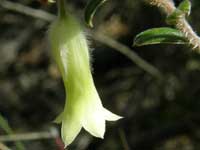
Apple Berry
Billardiera scandens
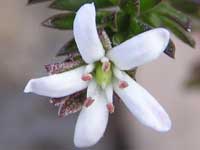
White Marianth
Rhytidosporum procumbens
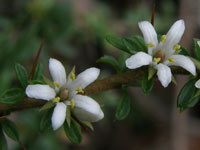
Bursaria longisepala
Flowering in summer, its flowers are 8mm across.
Here's another image.
The Plantaginaceae family has some 1,900 species in 107 genera worldwide. It includes snapdragons and foxgloves.
Genus Veronica - Speedwells
There's some 500 Veronica species worlwide - mostly in the northern hemisphere. There's 20 native Veronica species in NSW with 9 being recorded as being in the Blue Mountains.

Veronica brownii
Its distinctive Veronica flowers are about 10mm wide and its leaves have several prominent teeth.
Its leaves and stems have short nearly inconspicuous hairs.
Here's another image and another.


Bird's-eye Speedwell
Veronica persica
Also known as Persian Speedwell and Gypsyweed it has spread throughout the world.
On close-up it has distinctive leaves and stems.
Here's another image and another.
There are five species of this family recorded as being in the Blue Mountains National Park - all are members of the Comesperma genus. Only Mountain Milkwort (C. retusum) has so far alluded me - it looks similar to Matchsticks (C. ericinum) - but its leaves aren't recurved.
The two larger petals on Comesperma species are sepals.
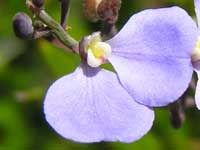
Fairies' Wings
Comesperma defoliatum
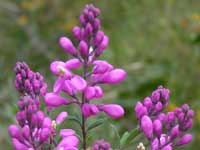
Matchheads
Comesperma ericinum
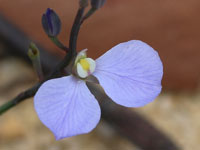
Broom Milkwort
Comesperma sphaerocarpum
Its lateral petals are edged with hairs and it grows in dry sclerophyll forests whereas Fairies' Wings prefers damper places.

Love Creeper
Comesperma volubile
Its linear leaves are up to 5cm long and 5mm wide.
Here's another image and another.
There are two native species of this family in the Blue Mountains and one weed. Worldwide it includes primroses and cyclamens.
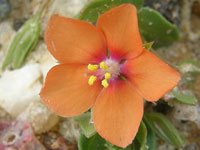
Scarlet Pimpernel
Lysimachia arvensis
It's not stoloniferous - that is, its stems don't produce roots at its nodes.
Here's how in looks from a distance.
Also known as the Blue Pimpernel as it comes in red, pink, orange and blue.
Here's another image and another.

There's several thousand species in the buttercup family (Ranunculaceae) worldwide and includes Ranunculus (buttercups), Clematis, Delphinium (delphiniums) and Helleborus (hellebores) genera. (Personally it seems odd to have clematis and buttercups in the same family).
Genus Clematis
There's eight species of the Clematis genus in NSW with three in the Blue Mountains.
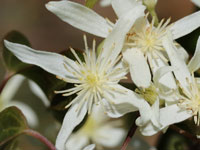
Headache Vine
Clematis glycinoides
Its flowers are 40mm across.
Its leaves have few teeth if any and its anther appendage is < 1mm - compared to Clematis aristata whose leaves are more serrated and an anther appendage > 1mm.
Its fruit has a wispy tail to be taken by the wind.
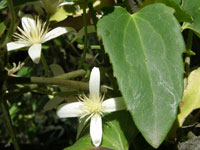
Old Man's Beard
Clematis aristata
Its sepals (not petals) seem to be wider and shorter.
Here's another image.
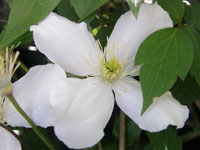
Mountain Clematis
Clematis montana
Its trifoliate leaves distinguish it from the other two Clematis species in the Blue Mountains. It is also deciduous.
Here's another image.
Genus Ranunculus (buttercups)
There's seven Ranunculus species recorded as being in the Blue Mountains with some 4-500 species worldwide.
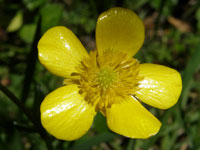
Creeping Buttercup
Ranunculus repens
Here's an image of its leaves.
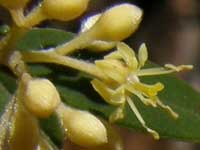
Andromeda Pomaderris
Pomaderris andromedifolia
The name Andromeda Pomaderris is not widely used.
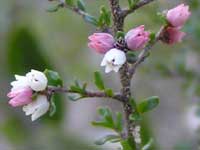
Bitter Cryptandra
Cryptandra amara
Its spine-like branches and 3mm long obovate leaves help identify it.
Its 3mm long flowers start out white, and then become pink, and eventually are a dusky pink with a "red centre".
Santalaceae, the sandalwood family, has some 1,000 species worldwide and includes the Native Cherry (Exocarpos cupressiformis), Australian Sandalwood (Santalum spicatum) and Quandong (Santalum acuminatum ). Here's an informative treatment of the Santalum genus.
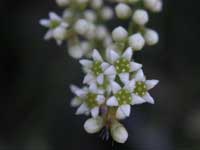

Acid Drops
Leptomeria acida
The tiny crimson flowers are less than 2mm wide. The fruit is a 5mm wide green grape-like drupe.
Here's another image.
Leptomeria species are endemic to Australia. There's only one species in the Blue Mountains.

Blunt Sandalwood
Santalum obtusifolium
The top of its recurved discolourous leaves are shiny with veins. Underneath, the leaves are dull.
There are four Santalum species in NSW, but only this one in the Blue Mountains.
Its fruit is initially green, maturing to purple.
Here's another image.
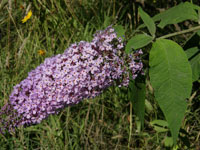
Buddleja
Buddleja davidii
Here's another image.
There are two species of this family in NSW - both of which are in the Blue Mountains.
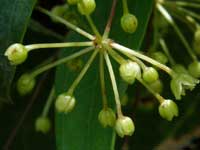
Native Sarsaparilla
Smilax glyciphylla
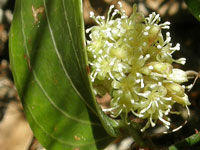
Genus Stylidium - Trigger-plants
There are 11 species of the Stylidium genus in NSW with 4 in the Blue Mountains. Although their flowers look similar, the different species are distinguished by their leaves.
The hammer-like trigger (column) is used to pollinate any insect that lands on the flower.
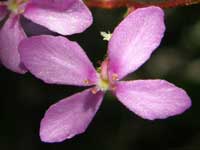
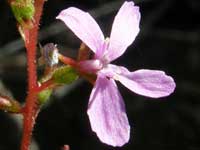
Grass Trigger-plant
Stylidium graminifolium
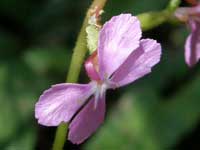
Triggerplant
Stylidium productum
The image shows a flower that has two triggers.
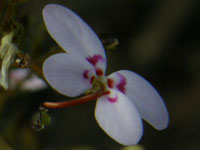
Tree Trigger-plant
Stylidium laricifolium
The colour of the flower varies from nearly white to pink.
Worldwide the Verbenaceae family has over 32 genera and 800 species. It includes Lemon Verbena (Aloysia citrodora).
The only native species recorded as being in the Blue Mountains is Native Verbena (Verbena gaudichaudii) - it is uncommon.
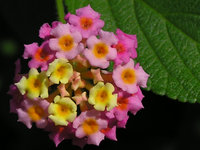
Lantana
Lantana camara
Any encounters with Lantana is likely to leave you with lots of scratches.
Lantana can’t decide whether it is a tree, a hedge or a vine - so it does all three.
Its colourful flower-heads are up to 30mm wide. Its unforgiving prickly branches are a light tan colour.
There are no native Lantana species in Australia
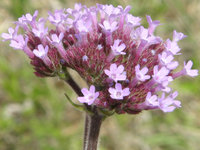
Purpletop Verbena
Verbena bonariensis
Its branches are four-sided and its flowers are 3mm across.
Butterflies seem to love it.
The Violet family includes 1,000 species of violets and pansies worldwide.
Genus Viola - Violets
Most Viola species are found in the temperate Northern Hemisphere. There are six native species in the Blue Mountains.

Mountain Violet
Viola betonicifolia
Its leaves have a long petiole (leaf stalk) and can be crenate (of a margin, with shallow, rounded teeth).
Its flowers are more often a darker blue.
Here's another image.
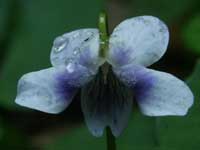
Native Violet
Viola hederacea
Its leaves are variable, and it is best identified by its white and purple flowers - which are 15mm wide.
Here's another image.
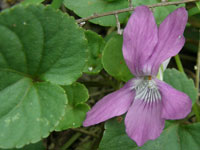
Common Dog-violet
Viola riviniana
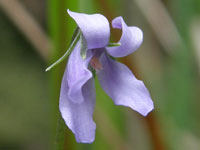

Heartsease
Viola tricolor
It has crenate leaves. (crenate: of a margin, with shallow, rounded teeth.)
Its seedpod has around 60 seeds.
Here's another image and another.
[Some references have it as a synonym of V. arvensis.]
Other genera of the Violaceae family
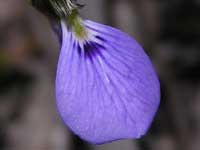
Slender Violet-bush
Hybanthus monopetalus
This species is also known as Lady's Slipper, and its multiple flowers on each stem, distinguishes it from H. vernonii.
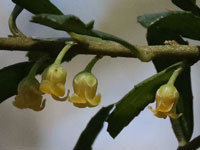
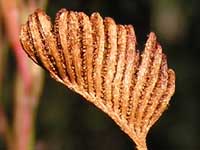
Forked Comb Fern
Schizaea bifida
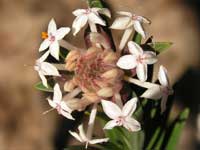
Slender Rice Flower
Pimelea linifolia ssp. linoides
It is also known as Granny's Bonnet.
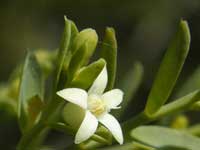
Olax
Olax stricta
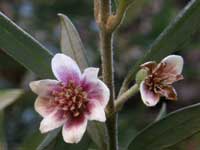
Black Sassafras
Atherosperma moschatum subsp. integrifolium
It is the only species in this genus.
Here's another image.
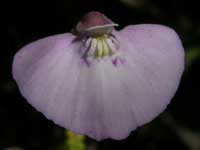
Single Bladderwort
Utricularia uniflora
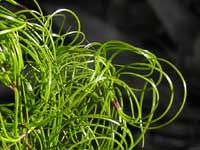
Curly Wig
Caustis flexuosa
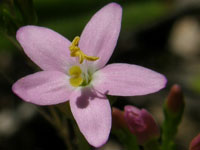
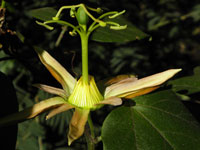
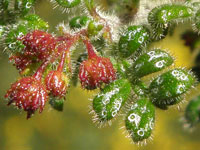
Pinnate Hop Bush
Dodonaea pinnata
Its characteristic seedpod shows it's a hop bush.
Here's an image of its branch and leaves, and another of its flowers.

ABN 76 425 202 457