
We acknowledge the traditional custodians of the land on which these plants grow - the Darug and Gundungurra people - and pay respect to their Elders past, present and emerging.
Note: Images marked as LCNP were taken in the Lane Cove National Park.
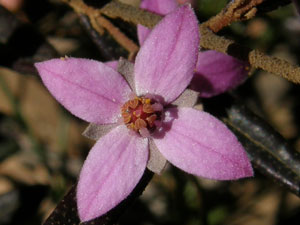 Sydney Boronia (Boronia ledifolia)
There are an estimated 320 species of the Rutaceae family in Australia, about 45 of these are in the Blue Mountains.
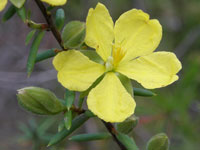
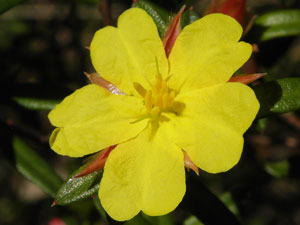 Blue Mountains Guinea Flower (Hibbertia bracteata)
The Dilleniaceae family is only represented by the Hibbertia genus in the Blue Mountains - but there are over 20 species.
The name Guinea Flower comes from the gold guinea coin.
A principal factor in identifying Guinea Flowers is the number and position of their stamens and carpels. For example the Blue Mountains Guinea Flower has about 16 yellow stamens and two green carpels.
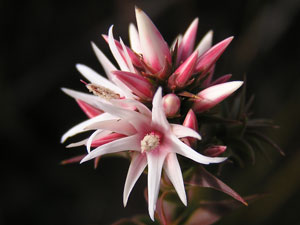 Pink Swamp Heath (Sprengelia incarnata)
Heaths. With over 4,000 species the Ericaceae family is large. It includes cranberry, blueberry, heather, rhododendron and azalea.
In 2002 the Epacridaceae family (Southern Heaths) was absorbed into the Ericaceae family (Northern Heaths).
There's over 80 species of the Ericaceae family in the Blue Mountains.
- Boronia genus
- Bronzy Boronia
- Deane's Boronia
- Fraser's Boronia
- Pale-pink Boronia
- Pinnate Boronia
- Small Leaved Boronia
- Sydney Boronia
- correa genus
- Common Correa
- Cyanothamnus genus
- Sticky Boronia
- Stiff Boronia
- Eriostemon genus
- Pink Wax Flower
- Boronia deanei subsp. deanei
- Boronia floribunda
- Boronia fraseri
- Boronia ledifolia
- Boronia microphylla
- Boronia pinnata
- Boronia thujona
- Correa reflexa var. reflexa
- Cyanothamnus anemonifolius subsp. anemonifolius
- Cyanothamnus rigens
- Eriostemon australasius
- Leionema dentatum
- Leionema lachnaeoides
- Leionema lamprophyllum subsp. orbiculare
- Phebalium squamulosum subsp. squamulosum
- Philotheca hispidula
- Philotheca myoporoides subsp. acuta
- Philotheca myoporoides subsp. myoporoides
- Philotheca obovalis
- Philotheca salsolifolia subsp. salsolifolia
- Zieria arborescens subsp. arborescens
- Zieria compacta
- Zieria covenyi
- Zieria cytisoides
- Zieria laevigata
- Zieria pilosa
The fragrance from Boronias comes from the oil in the leaves - and this requires a sunny day for it to be released. Boronia essential oil comes from Western Australia’s Boronia megastigma (Brown Boronia).
There's an estimated 9 Boronia species in the Blue Mountains.
Unlike most members of the Rutaceae family, Boronias have 4 petals - as do Cyanothamnus species and Zierias. Boronia and Cyanothamnus species have 8 stamens - Zieria species have 4.
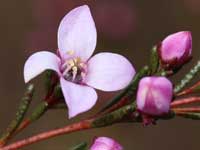
Deane's Boronia
Boronia deanei subsp. deanei
Its distinctive leaves are sessile and warty, and have an obtuse apex. They’re up to 10-12mm in length and are often appressed.
B. deanei subsp. acutifolia has not been recorded in the Blue Mountains and its leaves have an acute apex.
Here's another image and image.
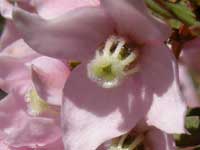
Pale-pink Boronia
Boronia floribunda
The eight hairy stamens give the impression that they are joined and look like a cage.
The leaves are pinnate with several leaflets and a mucro.
Here's another image and another.
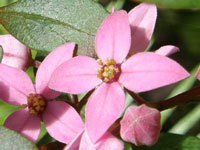
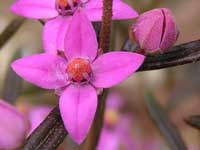
Sydney Boronia
Boronia ledifolia
Here's another image and an image with a pollinator.
Also available in pink and white.
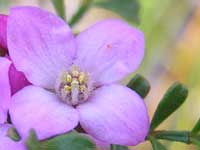
Small Leaved Boronia
Boronia microphylla
Its 5-8mm long leaves are pinnate - with half a dozen or so leaflet pairs.
Its petals overlap.
Here's another image and another.
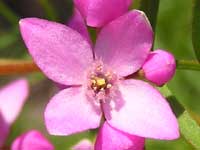
Pinnate Boronia
Boronia pinnata
From observation its leaves also appear to be narrower and although acute lack a mucro.
It flowers from winter through summer.
Here's another image.
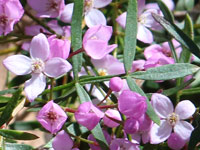
Bronzy Boronia
Boronia thujona
It also has a groove where its stems join the branch.
Correa genus
The Correa genus is endemic to Australia, with only one species in the Blue Mountains.
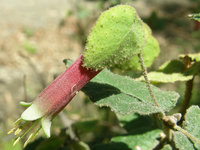
Common Correa
Correa reflexa var. reflexa
The two leaf-like bracts that hug the floral tube identify this C. reflexa variety.
It is also known as the Native Fuchsia.
Here's another image.
In 2020, 23 Boronia species were transferred into the Cyanothamnus genus. 4 of these are found in the Blue Mountains -
- B. anemonifolia now C. anemonifolius
- B. anethifolia now C. quadrangulus
- B. nana now C. nanus
- B. rigens now C. rigens
I am unable to see any obvious physical difference in the genera.
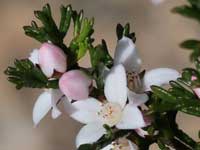
Sticky Boronia
Cyanothamnus anemonifolius
subsp. anemonifolius
The flowers are about 1cm across.
The leaves look sticky, but I can’t recall touching them.
Here's another image.
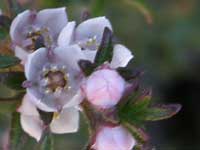
Stiff Boronia
Cyanothamnus rigens
Its tiny white flowers, that are usually not fully opened, and its mostly 3-foliolate leaves and hairy branchlets help identify it.
One needs to look closely to see the 8 stamens which characterise this species.
Here's another image and another.
Eriostemon genus
There's only one Eriostemon species in NSW. Several former Eriostemon species have been reclassified as Philotheca.
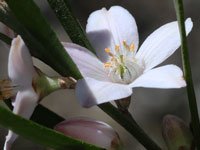
Pink Wax Flower
Eriostemon australasius
The colour varies from pale pink to red.
Here's another image showing pollinators.
Leionema genus
There are three Leionema species in the Blue Mountains, with several more further north in the Wollemi National Park.
Prior to 1998, all species within this genus were included in the genus Phebalium (Wikipedia).
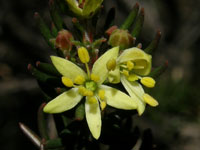
Leionema lachnaeoides
Its revolute (tightly recurved) leaves help identify it.
The plant shown here was lost in the Black Summer bushfires in 2019-20.
Here's another image and an image that shows a pollinator.
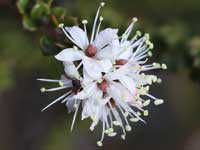
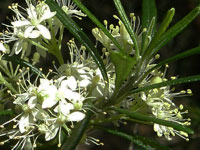
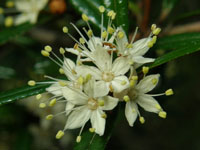
Shiny Phebalium
Leionema lamprophyllum
subsp. orbiculare
It grows in exposed ridges between Dunns Swamp and Newnes Plateau.
Forest Phebalium
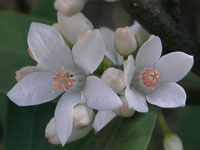
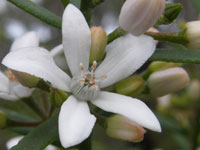
Phebalium squamulosum
subsp. squamulosum
PlantNet warns the "Intergrades occur between many of the subspecies".
Here's another image.
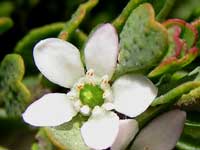
Wax Flower
Philotheca obovalis
The flowers are 20 mm wide and appear in Spring.
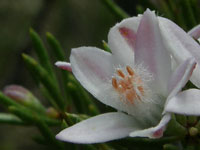
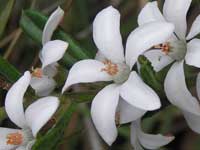
Rough Wax Plant
Philotheca hispidula
Previously known as Eriostemon hispidulus.
Here's a six petal flower.
Here's another image and another.
Zieria species are endemic to Australia - except for Zieria chevalieri that is endemic to New Caledonia. There are no Zieria species in Western Australia.
Zierias have four petals and four stamens. There are a dozen Zieria species in the Blue Mountains.
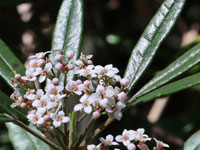
Forest Zieria
Zieria arborescens
subsp. arborescens
The lower surface of its leaves is covered in hair and there are secondary veins. The midvein has short, weak hairs.
It flowers in spring/summer.
Here's another image.
The decurrens subspecies is only known in the Jervis Bay area.
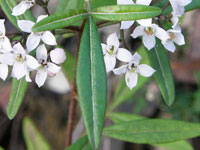
Zieria compacta
The leaves' paler lower surface has short white hairs and oil glands.
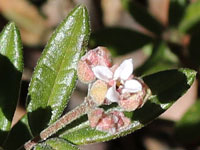
Coveny's Zieria
Zieria covenyi

Downy Zieria
Zieria cytisoides
The short hairs on its stems and leaves give it a dull colour.
Its central leaf is longer than the two side leaves. Its flowers can be 10mm across.
It flowers in spring.
Here's another image.
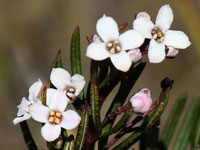
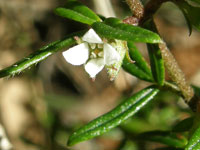
Hairy Zieria
Zieria pilosa
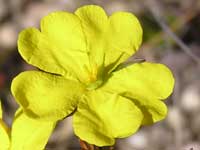
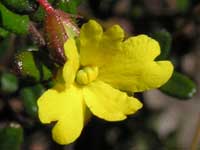
Brown Guinea Flower
Hibbertia rufa
It has 4 stamens and 2 carpels.
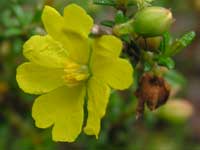
Thyme Guinea Flower
Hibbertia serpyllifolia
I imagine it gets its name from the similarity its leaves have to the younger leaves of the Common Thyme.
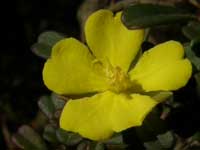
Leafy Guinea Flower
Hibbertia monogyna
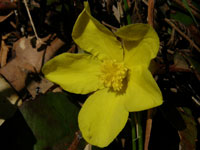
Golden Guinea Flower
Hibbertia scandens
The edges of its leaves can be either smooth or toothed - as shown on this image.
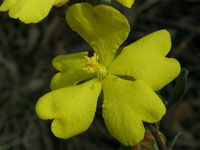
Grey Guinea Flower
Hibbertia obtusifolia
It has over 30 stamens and 3 carpels.
It's also known as the Hoary Guinea Flower.
- Epacris genus
- Blunt-leaf Heath
- Coral Heath
- Epacris apiculata
- Epacris browniae
- Epacris crassifolia
- Fuchsia Heath
- Keeled Heath
- NSW Coral Heath
- Swamp Heath
Leucopogon genus- Beard-heath
- Common Beard-heath
- Hairy Beard-heath
- Lance Beard-heath
- Small-leafed White Beard
- Styphelia genus
- Blunt Beard-heath
- Cranberry Heath
- Grey Beard-heath
- Pink Beard-heath
- Pink Five-Corners
- Prickly Beard-heath
- Red Five-Corner
- Star Beard-heath
- Styphelia fletcheri subsp. fletcheri
- Styphelia setigera
- Other heath genera
- Daphne Heath
- Native Cranberry
- Necklace Heath
- Peach Heath
- Pine Heath
- Pink Swamp Heath
- Prickly Broom Heath
- Rock Sprengelia
- Snow Wreath
- Spanish Heath *
* Introduced species (weed)
- Brachyloma daphnoides subsp. daphnoides
- Dracophyllum secundum
- Epacris apiculata
- Epacris browniae
- Epacris crassifolia subsp. crassifolia
- Epacris microphylla
- Epacris obtusifolia
- Epacris paludosa
- Epacris pulchella
- Epacris reclinata
- Epacris rigida
- Erica lusitanica *
- Leucopogon affinis
- Leucopogon amplexicaulis
- Leucopogon microphyllus var. microphyllus
- Leucopogon microphyllus var. pilibundus
- Leucopogon virgatus
- Lissanthe sapida
- Lissanthe strigosa subsp. subulata
- Lissanthe strigosa subsp. subulata
- Monotoca scoparia
- Sprengelia incarnata
- Sprengelia monticola
- Stenanthera pinifolia
- Styphelia appressa
- Styphelia attenuata
- Styphelia ericoides
- Styphelia fletcheri subsp. fletcheri
- Styphelia humifusa
- Styphelia mutica
- Styphelia setigera
- Styphelia sieberi
- Styphelia triflora
- Styphelia tubiflora
- Woollsia pungens
* Introduced species (weed)
The species in the Astroloma genus have been reclassified with most being now in the Styphelia genus.
The several dozen species are endemic to Australia, with most being in Western Australia and only two in NSW.
Some reference sources are yet to embrace this reclassification.
The two reclassified NSW Astroloma species are -
- Astroloma humifusum (Cranberry Heath) → Styphelia humifusa
- Astroloma pinifolium (Pine Heath) → Stenanthera pinifolia
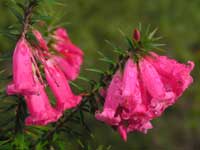
The Common Heath
Epacris impressa
It is not found as far north as the Blue Mountains.
There's over 20 species of the Epacris genus in the Blue Mountains.
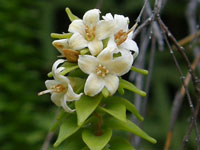
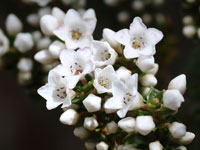
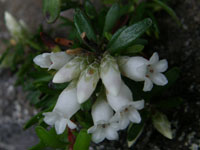
Epacris crassifolia
subsp. crassifolia
Its corolla (flower tube) is around 6mm in length.
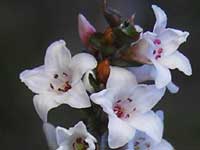
Coral Heath
Epacris microphylla
Here's another image.
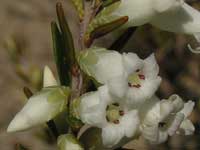
Blunt-leaf Heath
Epacris obtusifolia
Here's another image, and another and another .
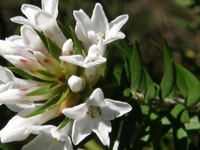
Swamp Heath
Epacris paludosa
It is also known as the Alpine Heath.
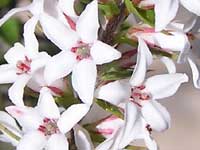
NSW Coral Heath
Epacris pulchella
It is also known as the Wallum Heath.
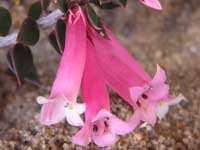
Fuchsia Heath
Epacris reclinata
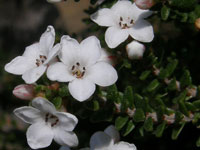
Leucopogons were once recognised by their hairy mouths. There was once 15 Leucopogon species recorded as being in the Blue Mountains, but following a reclassification, 11 of these are now in the Styphelia genus.
From my perspective there is now no easily observable way of distinguishing a Leucopogon species from a Styphelia species.
Some reference sources are yet to be updated with this reclassification.
The 11 reclassified Blue Mountains Leucopogon species are -
- L. appressus → S. appressa
- L. attenuatus → S. attenuata
- L. ericoides → S. ericoides
- L. esquamatus → S. esquamata
- L. exolasius → S. exolasia
- L. fletcheri subsp. brevisepalus
→ S. fletcheri subsp. brevisepalus
- L. fletcheri subsp. fletcheri
→ S. fletcheri subsp. fletcheri - L. fraseri → S. nesophila
- L. juniperinus → S. sieberi
- L. muticus → S. mutica
- L. setiger → S. setigera
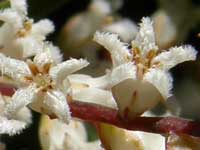

Beard-heath
Leucopogon amplexicaulis
The 5mm wide flowers appear in late winter.
Here's another image.
(not the crispest of images 😞)
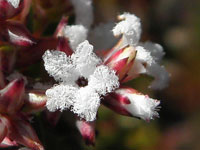

Hairy Beard-heath
Leucopogon microphyllus var. pilibundus
It has a fringe of hairs on its small recurved leaves; its branches are hispid (bristly).
Here's another image.

Common Beard-heath
Leucopogon virgatus
Here's another image and another.
Lissanthe species are endemic to Australia. There's three species recorded as being in NSW and all are in the Blue Mountains.

Native Cranberry
Lissanthe sapida
Its pendent flowers become red spherical fruit when ripe.
Here's another image.
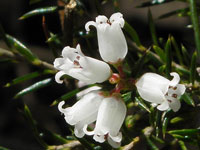
Peach Heath
Lissanthe strigosa subsp. strigosa
Both subspecies flower in spring.

Peach Heath
Lissanthe strigosa subsp. subulata
Its leaves are 6-16mm by 2mm with 3-5 ribs underneath.
Here's another image.
Sprengelia species are endemic to eastern Australia. Two of the three NSW species can be found in the Blue Mountains. The third species (S. sprengelioides) is found on the coast north from Newcastle.
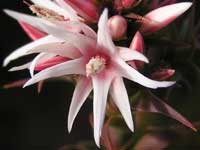
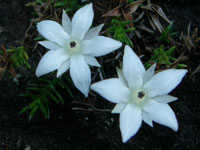
With the inclusion of the 11 former Leucopogon species (see above), there's now 17 Styphelia species recorded as being in the Blue Mountains.

Star Beard-heath
Styphelia appressa
The Star Beard-heath has appressed concave leaves with translucent tips on hairy branchlets.
Here's another image.

Grey Beard-heath
Styphelia attenuata
The Grey Beard-heath has grey-green leaves on crowded branches.
Here's another image and another.
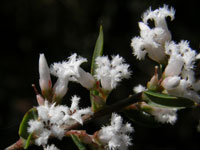
Pink Beard-heath
Styphelia ericoides
Just a hint of pink - but sometimes are not enough to identify it.
Its recurved pungent leaves that are at 45° to the branch and multiple flowers on a short stalk is a good indicator.
Here's an image with a pollinator.

Styphelia fletcheri
subsp. fletcheri
This endangered plant is primarily restricted to the Springwood area.
Its long pendulous flowers and recurved pungent leaves help identify it.

Cranberry Heath
Styphelia humifusa
Usually a small prostrate shrub with distinctive 10mm long bearded crimson flowers.
It has radiating toothed and pungent-pointed leaves.
Its fruit are 5mm wide spheres.
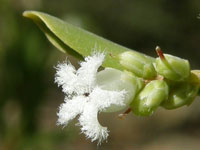
Blunt Beard-heath
Styphelia mutica
Its longer wider recurved leaves help identify it. As does the usual blunt end to its leaves - the leaves of most Leucopogon and Styphelia species tend to come to a point.
Its flowers are borne on spikes.
Here's another image - note the translucent corolla tube.


Pink Five-Corners
Styphelia triflora
The leaves are mostly flat to concave and tend to be clustered. Margins are entire.
The branchlets are hairless.
As with S. tubiflora, flowers may often be found that are red, yellow/green and even translucent.

Red Five-Corners
Styphelia tubiflora
The branchlets are hairy.
The flat to convex leaves have a sharp point and tend to radiate out from the branch. The end of the leaves remind me of the nose of a Concorde.
Here's another image
There's ten or so other genera of the heath family in the Blue Mountains - most with only one or two species.
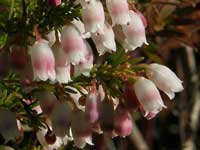
Spanish Heath
Erica lusitanica
Its leaves and whitish branches help identify it when it's not in flower.
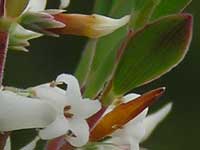
Daphne Heath
Brachyloma daphnoides subsp. daphnoides
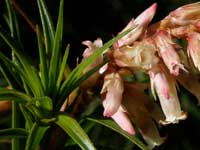
Necklace Heath
Dracophyllum secundum
It is often encountered on damp cliff faces next to stairs.
The necklace and branch can be over a metre in length.
Its floral tubes are about 10mm long.
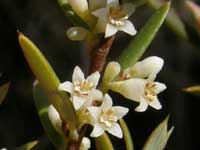
Prickly Broom Heath
Monotoca scoparia
Here's another image.

Pine Heath
Stenanthera pinifolia
An uncommon plant in the Blue Mountains with its only recording being made in 1998 by Haydn Washington and others in what is now the Gardens of Stone State Conservation Area.
A distinctive plant that is more likely to be found along the coast.
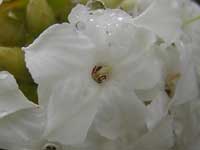
Snow Wreath
Woollsia pungens
Also recognised by the ripples on its petals.
This is the only species in this genus.
Here's another image.

ABN 76 425 202 457